

For many hospitals and clinics today, healthcare marketing feels like a constant effort to keep pace with growing competition and changing patient behavior. New campaigns are launched, social media channels are updated, and digital marketing for doctors continues to expand as advertising budgets rise. Yet despite this momentum, patient volumes often remain inconsistent.
This disconnect leads to an essential question: if marketing is working, why do results still feel unpredictable?
In most cases, the answer lies in how success is being measured.
Across the healthcare industry, performance is still widely judged by engagement figures, website traffic, and campaign visibility. While these indicators reflect activity, they rarely explain whether marketing is influencing real patient decisions. They do not reveal who is prepared to book, what builds lasting trust, or why some inquiries convert while others disappear.
Without the support of structured healthcare analytics, marketing remains reactive rather than strategic.
In an environment where competition is intensifying and patient expectations are rising, healthcare organizations must understand precisely which efforts drive appointments, strengthen credibility, and support sustainable growth.
This article explores how decision-makers can move beyond surface-level reporting and build marketing systems that deliver measurable, long-term patient outcomes.
The Real Problem with Healthcare Marketing Metrics Today
In healthcare digital marketing, dashboards often display growth in impressions, reach, engagement rates, follower counts, and click-through percentages. On the surface, these indicators suggest progress. However, in both hospital marketing and broader medical marketing environments, visibility does not automatically translate into patient growth.
For example, a patient who “likes” a post may never schedule an appointment. A video with thousands of views may not generate a single inquiry. A rapidly growing follower base does not guarantee higher consultation volumes.
In healthcare, decisions are deeply personal and often driven by trust, credibility, and perceived expertise. Patients rarely choose providers based solely on social media engagement. Instead, they rely on digital marketing for healthcare to support their research process by comparing providers, reading reviews, evaluating credentials, and seeking reassurance before taking action.
Vanity metrics often create a comforting narrative, and for leadership teams, this can distort strategic judgment within a hospital marketing strategy.
Executives may continue investing in underperforming channels because reports appear positive. Marketing teams may prioritize content that generates reactions rather than inquiries. Agencies may optimize for visibility instead of outcomes. Without clear links between healthcare marketing activity and patient outcomes, decision-makers are left to navigate growth strategies with limited visibility.

The Cost of Measuring the Wrong Marketing KPIs in Healthcare
Relying on the wrong healthcare marketing metrics directly affects business outcomes across healthcare marketing, hospital marketing, and patient acquisition marketing efforts. When organizations focus on surface-level indicators, several risks emerge.
- Budgets are allocated based on perceived engagement rather than actual return.
- High-potential channels remain underfunded, while low-impact campaigns continue to receive resources.
- Patient acquisition costs rise without corresponding improvements in conversion.
- Forecasting becomes unreliable.
- Scaling becomes difficult.
More importantly, leadership loses confidence in marketing as a predictable growth engine.
Without accurate healthcare digital marketing performance measurement supported by data analytics in healthcare, strategic planning becomes reactive. Organizations that fail to track meaningful indicators often struggle to identify what truly works, what needs refinement, and what should be discontinued.
As a result, healthcare marketing strategy and hospital marketing strategy evolve slowly, while patient expectations and market dynamics advance rapidly.
Understanding this gap is the first step toward building a performance-driven, patient-focused marketing system
How Patients Actually Choose Healthcare Providers in the Digital Age
Understanding why traditional healthcare marketing metrics fall short requires a closer look at how patients actually make decisions. Today’s healthcare patient acquisition process is no longer linear or immediate. It unfolds across multiple digital and offline touchpoints, often over days or even weeks, shaped by digital marketing for hospitals and evolving patient expectations.
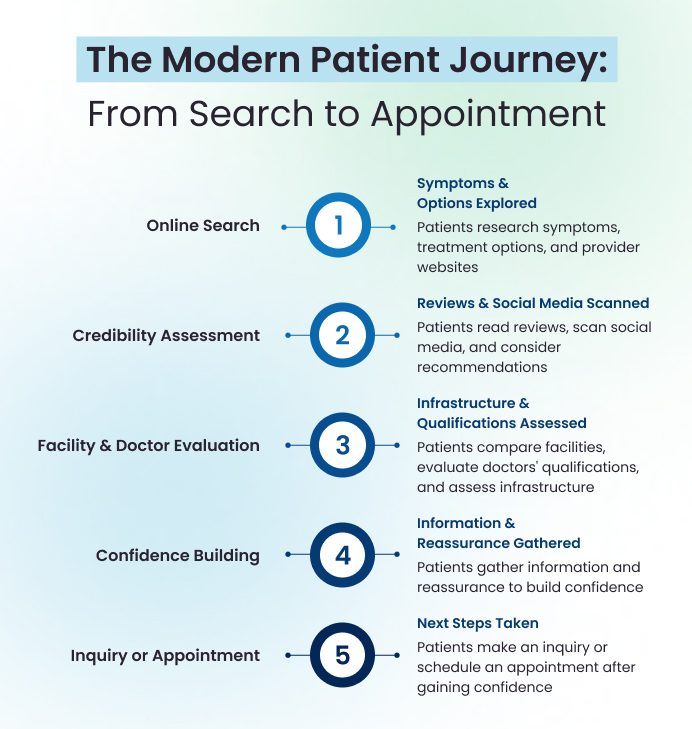
From the first search to the final booking, each interaction across websites, search engines, review platforms, and social channels contributes to perception, trust, and decision readiness. Effective healthcare patient acquisition depends on understanding and supporting this entire journey through consistent, data-informed healthcare marketing practices.
Healthcare choices involve personal risk and emotional investment, which makes trust central to decision-making. Patients look for consistent signals that confirm credibility and competence across both digital and physical touchpoints.
- Professional website design, clear service information, transparent pricing, and accessible contact options influence perception.
- Verified reviews, patient testimonials, case studies, and media mentions reinforce reliability.
- Doctor profiles, qualifications, and clinical experience strengthen confidence.
- Educational content created through strategic medical marketing demonstrates expertise.
- Prompt responses to inquiries signal professionalism and care.
Importantly, patients rarely rely on a single signal. They evaluate patterns. Consistency across platforms matters more than isolated claims. A strong reputation is built through repeated, reliable experiences across channels supported by effective healthcare digital marketing systems.
One of the most overlooked aspects of healthcare marketing is the timing of influence, which often begins long before a patient is ready to book.
Patient Lifetime Value and Retention Impact
Patient lifetime value measures the cumulative contribution of an individual across multiple interactions and services. It reflects follow-up treatments, ongoing care, diagnostic services, wellness programs, and loyalty-driven visits. Retention impact evaluates how healthcare marketing strategy and patient experience influence continuity of care.
Strong performance systems link acquisition channels to long-term outcomes. They identify which campaigns attract patients who remain engaged and which produce short-term volume without lasting value. This insight enables organizations to prioritize quality over quantity within their hospital marketing strategy.
Together, these patient acquisition metrics provide a comprehensive view of how healthcare digital marketing performance translates into real clinical and commercial outcomes, supporting sustainable, data-driven decision-making.
Why Most Healthcare Brands Struggle to Track Marketing Performance
Despite growing investments in digital platforms, healthcare analytics, and reporting tools, many healthcare organizations still struggle to gain clear visibility into healthcare marketing performance. While digital marketing for healthcare and digital marketing for hospitals continue to expand, meaningful insight into patient acquisition and conversion remains limited.
Many of the challenges outlined below stem from structural, technological, and organizational limitations that restrict effective marketing attribution in healthcare and weaken data analytics in healthcare environments.
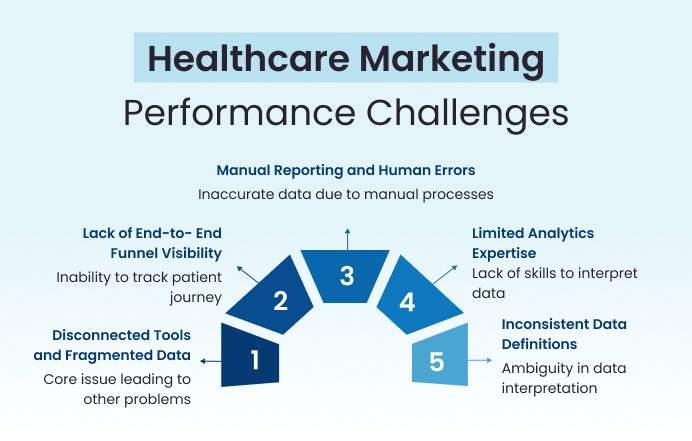
Together, these healthcare marketing challenges create an environment where performance measurement becomes fragmented, delayed, and unreliable. Without addressing these barriers through an integrated healthcare marketing strategy, automation, and unified data systems, even well-designed medical marketing and hospital marketing campaigns struggle to deliver predictable, scalable results.
How Data, AI, and Automation Transform Healthcare Marketing Measurement
Artificial intelligence is rapidly reshaping how healthcare organizations operate, analyze performance, and engage patients. The global artificial intelligence (AI) in healthcare market size is expected to reach USD 765.12 billion by 2035, reflecting the scale at which intelligent technologies are being adopted across clinical, administrative, and healthcare marketing functions.
As competition intensifies and patient journeys become more complex, traditional reporting systems within healthcare digital marketing and hospital marketing environments are no longer sufficient. Organizations are increasingly adopting AI in healthcare marketing, healthcare analytics, and integrated automation platforms to improve visibility and accountability.
Using AI to Identify High-Intent Patient Behavior
In modern healthcare marketing, not every inquiry represents genuine readiness for care. Some prospects are in early research stages, while others are actively seeking immediate treatment. AI enables organizations to distinguish between these groups using predictive analytics, healthcare models, and advanced data analytics in healthcare.
By analyzing behavior across websites, search activity, content engagement, form interactions, and response patterns, AI systems can identify high-intent signals that indicate strong booking potential. These insights allow marketing and operations teams to prioritize qualified prospects, personalize engagement, and allocate resources more efficiently within patient acquisition marketing programs.
Automating Lead Tracking and Follow-Ups
Manual processes often lead to delayed responses, missed inquiries, and fragmented communication. Over time, this erodes patient trust and reduces acquisition efficiency. Healthcare marketing automation and marketing automation for hospitals address this challenge by creating structured, intelligent workflows.
Automated systems capture leads across digital marketing for healthcare channels, assign them to relevant teams, trigger personalized messages, schedule reminders, and track engagement history. These workflows ensure timely responses, consistent communication, and continuous nurturing throughout the patient journey.
Building Real-Time Performance Dashboards
Traditional healthcare reporting relies heavily on periodic summaries that reflect past performance. Data-driven healthcare marketing replaces this model with real-time visibility supported by unified healthcare analytics systems.
Integrated dashboards consolidate data from advertising platforms, websites, CRM systems, call tracking tools, and appointment software into unified views. Leadership teams can monitor lead flow, channel effectiveness, conversion patterns, and cost trends as they occur across digital marketing for hospitals and medical marketing initiatives.
This immediate access to performance insights enables faster adjustments, more informed budgeting, and stronger accountability across departments.
Predicting Growth Opportunities with Advanced Analytics
The true power of AI lies in prediction. Advanced analytics platforms analyze historical data to uncover patterns in patient behavior, service demand, and channel performance. These insights support predictive analytics healthcare capabilities and enable more precise healthcare marketing strategy development.
Predictive models can identify emerging high-demand services, forecast seasonal fluctuations, optimize campaign timing, and highlight underserved patient segments. This enables proactive planning, improved resource allocation, and more confident investment decisions across hospital marketing strategy initiatives.
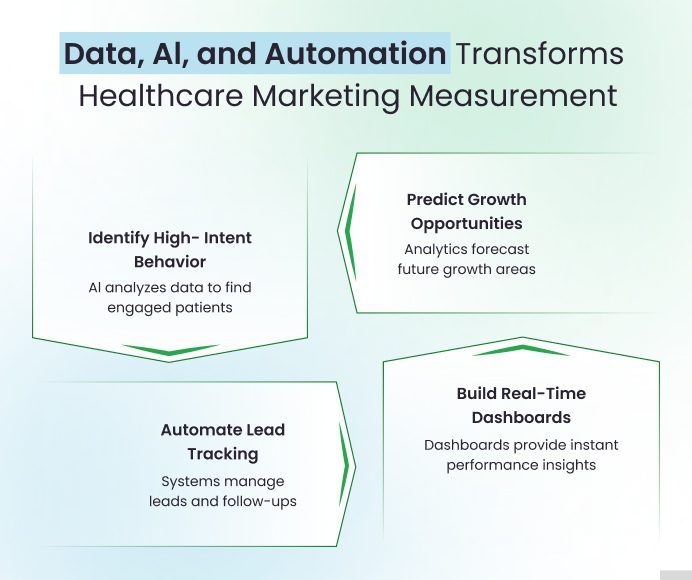
By integrating AI, automation, and advanced analytics into performance systems, healthcare organizations gain precision, scalability, and foresight. These capabilities form the foundation of sustainable, data-driven healthcare marketing in an increasingly competitive landscape.
How Strategic Healthcare Marketing Analysis Unlocks Hidden Growth
Even when healthcare organizations invest in modern tools, advanced analytics, and automated systems, growth often remains below potential. In many cases, this is because revenue is quietly leaking across the healthcare marketing and hospital marketing conversion funnel.
These leakages occur at multiple stages.
- High-intent prospects abandon complex forms.
- Website visitors fail to find relevant service information.
- Inquiries receive delayed responses.
- Follow-up communication lacks personalization.
- Appointment scheduling systems create friction.
- Patients disengage before treatment begins.
Individually, these gaps may appear minor. Collectively, they represent significant lost revenue for medical marketing and digital marketing for hospital initiatives.
Strategic healthcare marketing analysis focuses on identifying and eliminating these hidden inefficiencies. By examining the complete patient journey across healthcare digital marketing, digital marketing for doctors, and offline touchpoints, organizations gain visibility into where interest weakens, where trust declines, and where conversions fail.
This analysis goes beyond surface-level metrics. It integrates behavioral data, operational performance, response timelines, channel attribution, and patient feedback using advanced healthcare analytics and data analytics in healthcare systems. It evaluates how digital platforms, internal processes, and communication systems interact. Most importantly, it connects healthcare marketing activity directly to clinical and financial outcomes.
Through this comprehensive approach, leadership teams can detect structural weaknesses that standard hospital marketing reports often miss. However, insight alone does not generate growth.
The true value of healthcare marketing analysis lies in its ability to transform observations into sustainable systems. Once revenue leakages are identified, organizations must redesign their patient acquisition marketing processes, communication workflows, and digital marketing for healthcare infrastructure to prevent recurrence.
Over time, these improvements form repeatable growth frameworks rather than isolated fixes and support long-term healthcare marketing strategy and hospital marketing strategy execution.
Within this system-driven approach, organizations typically pursue two parallel strategies.
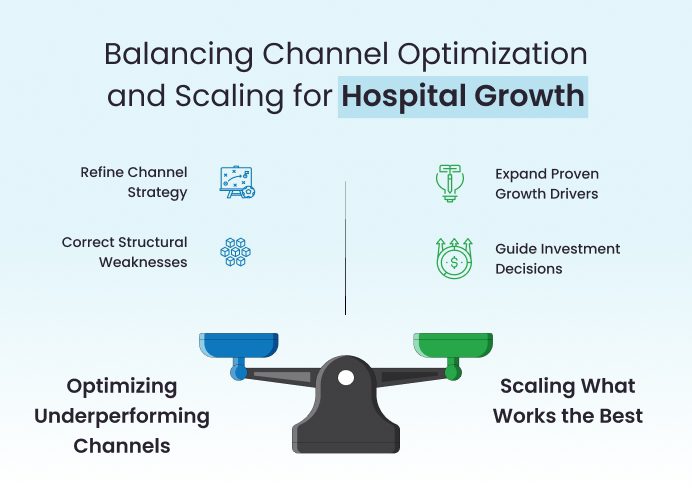
Rather than relying on sporadic campaigns or short-term experimentation, organizations build interconnected systems that continuously improve performance. Through disciplined healthcare marketing analysis, hidden potential is converted into measurable, scalable, and sustainable progress.
What Decision-Makers Should Ask Before Investing in Marketing
Marketing today is not “anyone’s job.” It requires structured systems, strong analytical capability, regulatory awareness, and a deep understanding of patient behavior supported by healthcare analytics and data-driven healthcare marketing practices. Without this foundation, even well-funded healthcare marketing and digital marketing for hospital campaigns struggle to deliver consistent, measurable results.
As healthcare organizations evaluate new tools, partners, or healthcare marketing automation platforms, these decisions must be made with the same rigor applied to clinical and operational investments. Whether selecting a healthcare marketing agency, refining a hospital marketing strategy, or expanding digital marketing for healthcare initiatives, the right choice accelerates patient acquisition marketing and long-term growth. The wrong one leads to wasted time, budget, and missed opportunities.
Before committing to any healthcare marketing investment, leadership teams should evaluate their strategy using the following questions:
- Are we tracking real patient outcomes or only campaign activity and engagement metrics?
- Do we have clear visibility across the entire patient acquisition funnel, from first interaction to treatment?
- Can we accurately attribute revenue to specific channels, campaigns, and touchpoints?
- Is our marketing system built to scale with future growth and service expansion?
- Are AI, automation, and predictive analytics being used to improve performance and decision-making?
- Do our reporting systems provide real-time, actionable insights for leadership?
- Are our internal teams and partners aligned around measurable business outcomes?
Strong marketing systems are built on clear answers to these questions. When leadership teams can evaluate performance, attribution, and scalability with confidence, marketing becomes a predictable growth engine rather than a cost center.