





May 26/2026

Before we begin, ask yourself: Is your digital presence a welcoming front door for patients, or a confusing maze that turns them away?
The patient’s journey, in the current era, begins on a screen long before they reach the clinic. With the rise in popularity of AI and modern social media platforms, healthcare digital marketing has shifted from conventional advertising to building digital trust.
For hospitals and clinics, staying relevant and visible today means creating seamless, “mobile-first,” or let’s say “digital” experiences. This guide highlights essential healthcare digital marketing strategies, platforms, and trends you need to navigate through this high-stakes landscape—ultimately helping you turn digital engagement into meaningful patient care.
Are You Losing Patients to Competitors Ranking Above You?
Get Page-One RankingsWhat Is Healthcare Digital Marketing?
It wouldn’t be wrong to call healthcare digital marketing a compilation of strategies and tactics that healthcare organizations use to reach their consumers and patients. This set of tactics and strategies is based on digital channels—whether that is social media, web, SMS, or email—to deliver the right information at the right time.
In layman’s terms, medical professionals and hospitals build their digital presence to ensure their practice shows up and earns trust whenever a patient looks up a certain treatment, reads reviews, or searches for a relevant specialist.
Considering that we are in the digital age, patients are no longer quiet receivers. Instead, they are empowered and knowledgeable consumers making active decisions when it comes to their health. That is where digital marketing comes in as the central nervous system of patient acquisition.
Key activities of healthcare digital marketing include:
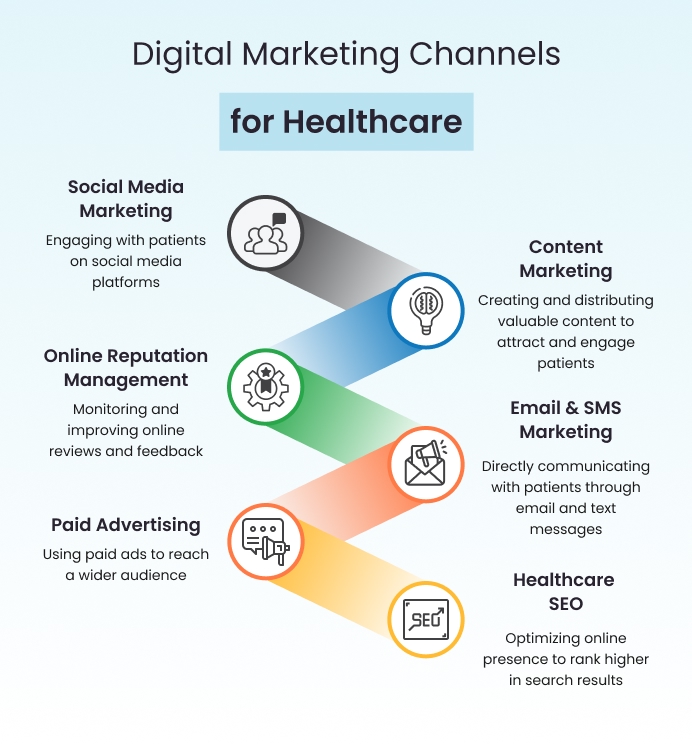
- Healthcare SEO (Search Engine Optimization): Ensures that the healthcare organization appears on Google SERPs when patients search for relevant queries. A strong healthcare SEO strategy is the backbone of long-term patient acquisition.
- Social media marketing: Helps build community and trust on digital platforms like YouTube, Facebook, and Instagram. Effective healthcare social media marketing creates a loyal patient community around your brand.
- Healthcare content marketing: Focuses on FAQs, educational content, and videos that solve patient concerns. Consistent healthcare content marketing positions your practice as a trustworthy authority.
- PPC (Paid advertising): Includes Meta Ads and Google Ads to put your services in front of potential patients.
- Online reputation management: Collecting and managing patient reviews across Google and directories.
- Email and SMS marketing: Ensures that patients receive health tips, appointment reminders, and follow-ups.
Overall, digital marketing for hospitals, clinics, and medical professionals to promote their services, connect with potential patients, and build brand recognition.
The amount of trust involved in healthcare digital marketing is something that makes it different from the digital marketing of other industries. The aim here is to educate, gain trust, and convert.
Importance of Digital Marketing in the Healthcare Industry
Digital marketing for healthcare organizations and providers is about making healthcare accessible to the people in need.
The significance of digital marketing in this industry is briefly articulated below.
Expands Accessibility and Reach
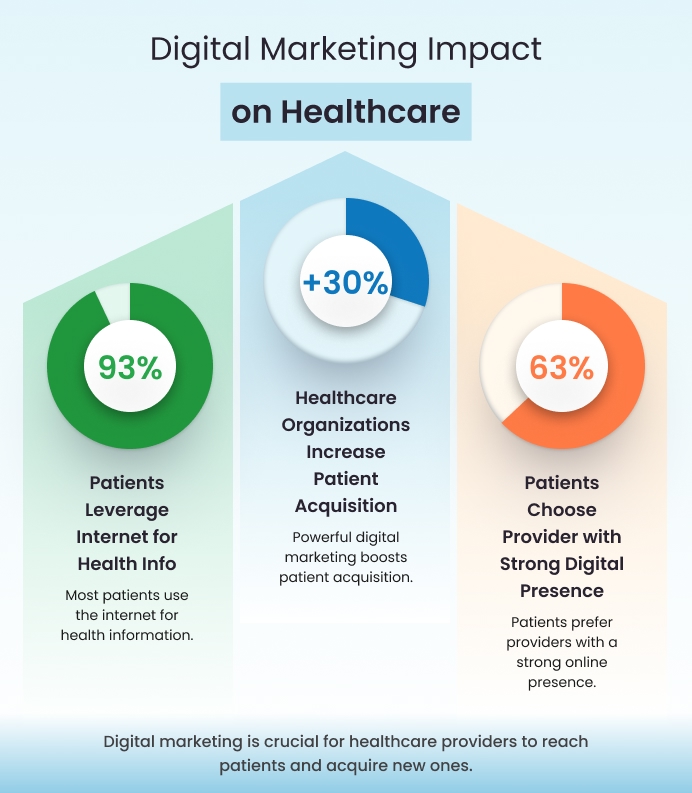
Patients today significantly rely on technology to make decisions, leaving behind conventional marketing like high-cost broadcasting.
On the contrary, digital marketing gives healthcare providers an excellent platform and head start to reach a wider set of audiences. Well, the data backs this statement excellently.
Enhancing Patient Experience and Engagement
Gone are the days when patients appreciated waiting rooms as facilities. Instead, a significant part of patient experience and engagement is shaped through digital marketing. It enables patients to book appointments on a tap and access health info via interactive applications and channels.
Key Benefits of Digital Marketing for Clinics and Hospitals
It wouldn’t be wrong to say that searches these days drive more results to hospital websites than any referrals. If your clinic is not visible on the SERPs, note that your competitor is enjoying the attention.
A strong healthcare digital marketing strategy delivers the following benefits:
Increased Visibility
Through SEO, local search, and Google Business Profile optimization, your hospital appears exactly when a nearby patient is ready to book. “Near me” healthcare searches have grown over 200%, making local digital visibility one of the highest-leverage assets a clinic can own.
Cost-effective Acquisition
Unlike print or TV ads, every digital campaign is trackable. Hospitals and clinics achieve conversion rates of up to 12.33%, among the highest across all healthcare subcategories. You know exactly what is working and where to reinvest.
Higher Patient Trust
94% of patients use online reviews to evaluate providers before making a decision. Consistent content like educational blogs, doctor videos, and patient testimonials builds the credibility that converts a first-time visitor into a booked appointment.
Measurable ROI (Return on Investment)
Every rupee spent on digital marketing generates data. That data tells you which channels bring real patients and which ones to cut.
Better Patient Retention
SMS reminders, email follow-ups, and social media keep patients engaged between visits, reducing drop-offs and increasing lifetime value without significant additional spend.
Important Digital Marketing Channels for Clinics and Hospitals
Not all digital marketing channels drive the same results for clinics and hospitals. The right mix depends on your budget, speciality, and goals. Some of the most important digital marketing channels consistently delivering results for hospitals and clinics include:
Healthcare Marketing Trends to Watch in 2026
In 2026, healthcare leaders aren’t outspending the competition; they’re out-adapting them. Here is what’s shifting the landscape:
AI-Powered Search & AEO (Answer Engine Optimization)
Patients have moved beyond traditional search to AI engines. If your content isn’t structured for Answer Engine Optimization (AEO), your practice is effectively invisible.
Short-Form Video
Authenticity is the new production value. 60-second clinician explainers on Reels or TikTok now outperform polished brand videos, accounting for over 50% of social engagement.
Hyper-Personalization
Patients expect retail-level personalization. Using first-party data to send targeted, human-centric communications based on appointment history is now the gold standard.
The Telehealth “Front Door”
Practices offering integrated telehealth and in-person booking options convert significantly more first-time patients. Virtual care is no longer a perk; it is a primary acquisition funnel.
24/7 AI Engagement
AI chatbots now handle bookings and FAQs around the clock, capturing leads that would previously have been lost after hours.
Top Digital Marketing Challenges & Solutions
Healthcare marketing requires navigating high stakes and strict regulations. Here is how to overcome the modern hurdles:
- HIPAA Compliance: Tools like Meta Pixels can inadvertently leak PHI.Solution: Use server-side tracking and ensure all vendors sign Business Associate Agreements (BAAs).
- The Trust Deficit: In an era of AI-generated content, patients are skeptical of generic content. Solution: Lead with real people. Doctor-led videos and verified patient testimonials build unshakeable credibility.
- Local Competition: Every clinic is fighting for the same search keywords. Solution: Consistency beats budget. Update Google Business Profiles weekly and manage reviews at scale to dominate local SEO.
- The Conversion Gap: Clicks don’t matter if they don’t lead to appointments. Solution: Audit the patient journey. Ensure the booking process takes fewer than three clicks and functions seamlessly on mobile.
Measuring ROI in Healthcare Digital Marketing: A Guide for Hospitals and Clinics
There is no improvement without measurement. Tracking right and real numbers in healthcare digital marketing is the difference between growing and guessing. Key metrics that actually measure and matter here are:
- Conversion Rate: A standard conversion rate for hospitals and clinics in the healthcare subcategory is 12.33%, considerably above the industry average. If yours falls below 3%, the problem is rarely the ad. It is usually the landing page, the CTA, or the booking experience.
- CPC (Cost Per Click): The average healthcare CPC sits at $3.17 (₹ 298.15), but this varies widely by specialty and competition. A low CPC with poor conversion is a waste of your spending. A slightly higher CPC on a high-intent keyword that fills appointment slots is money well spent. Always evaluate CPC alongside conversion, not in isolation.
- Lead Generation: Leads are potential patients engaging with the forms, newsletter sign-ups, and callback requests on your website. Volume is important; however, quality matters more. A hundred unqualified leads will always lose to ten high-intent ones.
- NPS (Net Promoter Score): The average healthcare NPS sits between 30 and 50, with top performers scoring above 50. A high NPS means patients are satisfied and are referring others, effectively becoming your lowest-cost acquisition channel.
- PAC (Patient Acquisition Cost): The true cost of gaining one new patient is total marketing spend divided by new patients acquired. A healthy PAC-to-lifetime-value ratio should be at least 3:1 for sustainable growth. If your PAC is creeping up without a matching rise in patient value, something in your funnel is leaking.
- Patient Retention Rate: Acquiring a patient once is good. Keeping them is better. Retention rate tells you whether your post-visit experience — follow-ups, reminders, and ongoing content- is doing its job long after the appointment ends.
- ROI (Return on Investment): ROI is the metric that ties everything together. If email marketing delivers a 5:1 ROI while display ads return 2:1, the smart move is to reallocate budget toward what is actually working. ROI connects every campaign back to one question: Did this bring in revenue that justifies the spend?
- Social Media Metrics: Follower count is vanity. What matters is reach, engagement rate, and most importantly, whether social activity is driving appointment-linked actions. Track click-throughs from social posts, video views on doctor content, and direct messages that convert into booked visits
- Website Traffic: Your website is your 24/7 front desk. 70% of healthcare marketers report growth in website traffic directly from SEO investment. Track where visitors come from — organic, paid, or social, and whether that traffic is actually converting into appointments.
Ready to Turn Your Clinic’s Digital Front Door Into a Patient Magnet?
Book Free AuditWhat to Expect with MedGrowthEngine.ai?
MedGrowthEngine.ai, as an all-in-one growth platform, is designed specifically for the healthcare industry. As a dedicated healthcare digital marketing agency, it builds a high-performance “growth engine” for healthcare organizations and service providers. When partnering with us, you can expect a smooth transition from scattered digital tactics to a structured, four-phase expansion model: Diagnose, Prescribe, Treat, and Scale.
Deliverables you can expect:
AI-Powered Patient Acquisition
We leverage AEO (Answer Engine Optimization) and high-intent local SEO to ensure your healthcare organization or service secures the top position when patients search for relevant queries or keywords.
Automated Patient Nurturing
24/7 engagement with the help of AI chatbots and WhatsApp automation focuses on handling FAQs, follow-ups, and appointment reminders.
Conversion-Optimized Infrastructure
You can expect mobile-first, high-speed landing pages and websites designed to turn “clicks into consultations” with minimum booking flows.
Data-driven growth intelligence
Real-time dashboards provide clear visibility into your ROI, tracking every lead from the first touchpoint to the final appointment.
As a full-service healthcare marketing agency, MedGrowthEngine.ai integrates technology with clinical empathy, ensuring your clinic remains trusted, visible, and consistently booked.
Conclusion
The future of healthcare organizations depends on integrating advanced technology with clinical empathy. By leveraging platforms like MedGrowthEngine.ai, providers can automate the “front-door” experience while adhering to HIPAA standards and maintaining the essential human touch.
Frequently Asked Questions
Traditional marketing builds broad awareness but is hard to track. Digital marketing is intent-based, targeting specific patient needs in real-time with measurable data.
AEO optimizes content for AI assistants to provide direct answers. It uses structured Q&A to ensure your clinic is the cited source for medical queries.
Hospitals track metrics like PAC (Patient Acquisition Cost), appointment bookings, and LTV (Lifetime Value) to compare marketing spend against long-term revenue.
LinkedIn is best for professional networking, while Instagram and Facebook are ideal for community building and health education.
It focuses on Local SEO and E-E-A-T (Experience, Expertise, Authoritativeness, and Trustworthiness). Google prioritizes medical content verified by professionals to ensure patient safety.