





May 15/2026

Not long ago, hospitals could grow through basic advertising, referrals, and local visibility. Today, many healthcare organizations are spending heavily on digital marketing, yet still struggling with inconsistent patient flow, missed inquiries, and unstable revenue.
This is the new reality of healthcare growth. Patients now research online, compare providers, and expect quick responses, while internal teams remain stretched, systems disconnected, and many genuine leads are lost before conversion. In this environment, promotions alone are no longer enough. Without strong follow-up systems, data tracking, and performance management, marketing efforts often fail to deliver sustainable results.
This creates a critical decision point for hospital leaders and marketing heads to choose between a healthcare marketing agency that focuses on visibility and a healthcare growth consultant. This blog explores that difference. We’ll compare what each approach offers, the problems they solve, and how to choose the right partner for your hospital’s long-term success.
Understanding the Role of a Healthcare Marketing Agency
A healthcare marketing agency is a specialized service provider that helps hospitals, clinics, and medical practices promote their services, build brand visibility, and attract potential patients through various online and offline channels. Their primary focus is on creating awareness, generating interest, and positioning healthcare organizations effectively in a competitive market.
Typically, healthcare marketing agencies manage promotional activities, design communication strategies, and execute campaigns aimed at increasing reach and engagement.
Most agencies offer a set of core services, including:
- Branding: Developing a consistent identity through logos, messaging, and visual elements that reflect the hospital’s values and credibility.
- Advertising: Running paid campaigns on platforms like Google, social media, and local media to drive traffic and inquiries.
- Content: Creating blogs, videos, posts, and educational materials to inform patients and strengthen online presence.
- Campaigns: Planning and executing short-term or seasonal promotions around services, health awareness days, or new offerings.
Where healthcare marketing agencies truly add value is in building visibility and recognition. They help hospitals stand out in crowded markets, improve their online footprint, and maintain a professional public image. For organizations that are new, rebranding, or entering a competitive region, agencies can play an important role in establishing credibility and generating initial traction.
Convert More Inquiries Into Booked Appointments
Start With the Growth AuditWhat Is a Healthcare Growth Consultant?
With increasing marketing costs and rising patient expectations, hospitals cannot rely only on campaigns to grow. They need reliable processes that ensure every inquiry is tracked, followed up, and converted efficiently.
This is where growth consultants think differently.
A healthcare growth consultant works with hospitals and clinics to design and implement structured systems that drive consistent and measurable growth.
- They improve how inquiries are handled, how patients are converted, and how relationships are maintained over time.
- They focus on maximizing the value of existing opportunities by strengthening response systems, improving follow-up discipline, aligning marketing with operations, and removing inefficiencies that limit performance.
- They also focus on building scalable growth models by standardizing key workflows, improving team accountability, and creating frameworks that support expansion without increasing chaos or dependency on individuals.
At the core of this approach are data-driven growth frameworks. These use CRM insights, performance dashboards, and operational analytics to monitor results, identify gaps, and guide continuous improvement. As a result, growth becomes predictable, measurable, and sustainable.
Healthcare Marketing Agency vs. Growth Consultant: A Quick Comparison
One of the simplest ways to understand the difference between a healthcare marketing agency and a healthcare growth consultant is to compare how each approaches growth. When viewed side by side, the contrast becomes clear and helps hospital leaders identify what their organization truly needs.
| Area of Comparison | Healthcare Marketing Agency | Healthcare Growth Consultant |
|---|---|---|
| Strategic Focus | Focuses on executing marketing activities such as ads, creatives, and promotions | Focuses on building long-term growth strategies aligned with business goals |
| Approach | Campaign-driven and centered around individual promotions | System-driven with continuous optimization of processes |
| Growth Objective | Generates short-term leads and visibility | Builds long-term, predictable patient growth |
| Performance Measurement | Tracks impressions, clicks, and inquiries | Measures conversions, revenue impact, and ROI |
| Scope of Work | Limited mainly to marketing functions | Covers marketing, operations, and patient journey optimization |
| Accountability | Accountable for campaign performance | Accountable for business outcomes and growth results |
This comparison highlights a fundamental difference: while marketing agencies focus on promotion and visibility, growth consultants focus on building structured systems that convert visibility into sustainable business growth.
Problems Marketing Agencies Solve Well (And Where They Struggle)
Healthcare marketing agencies are especially effective in addressing visibility and promotion-related challenges that many healthcare organizations face in competitive regions. Through structured campaigns and creative execution, agencies help hospitals reach wider audiences and strengthen their public image.
Improving Online Visibility
Marketing agencies are highly effective at increasing a hospital’s digital presence. They optimize websites, manage social media profiles, improve search rankings, and list healthcare organizations on relevant platforms. This helps hospitals appear more frequently in online searches and increases brand awareness among potential patients.
Running Ad Campaigns
Agencies specialize in planning and executing paid campaigns across Google, social media, and local digital channels. They design creatives, manage budgets, and optimize ads to generate inquiries. This is one of their strongest areas, especially for promoting specific services, doctors, or seasonal health programs.
Managing Brand Presence
Maintaining a consistent and professional brand image is another area where agencies add value. They develop communication guidelines, visual themes, and messaging frameworks that ensure uniformity across websites, advertisements, and social media platforms. This helps build trust and credibility in the market.
Despite these advantages, marketing agencies face some important limitations:
- Limited involvement after lead generation, resulting in delayed responses, weak call handling, and inconsistent follow-ups
- Minimal control over internal workflows, CRM usage, and staff accountability
- Gaps between marketing efforts and on-ground execution
- Poor alignment between promotion, patient handling, and service delivery
- Lower conversion rates and weaker long-term patient engagement
Overall, healthcare marketing agencies excel at creating visibility and generating interest. However, when it comes to converting that interest into consistent revenue and loyal patients, their limitations become evident, highlighting the need for a more integrated growth approach.
Problems Growth Consultants Are Designed to Solve
In the fast-paced world of healthcare marketing, clinics and hospitals often face hidden bottlenecks that stall growth. Growth consultants step in as strategic partners, pinpointing these issues and deploying proven solutions to unlock scalable revenue and sustainable patient acquisition.
- Lead-to-appointment conversion issues: They diagnose why high-quality leads fizzle out, implementing targeted follow-up strategies, personalized nurturing sequences, and booking funnels that significantly improve conversion rates.
- Patient journey optimization: Mapping every touchpoint from awareness to retention, consultants streamline experiences to reduce drop-offs, enhance satisfaction, and foster lifelong loyalty.
- CRM and automation integration: Bridging silos between tools like Go High Level or HubSpot, they automate workflows for seamless data flow, saving hours on manual tasks and enabling hyper-personalized outreach.
- Reducing revenue leakage: Identifying lost opportunities in no-shows, incomplete treatments, or pricing gaps, consultants recover up to 20% of untapped revenue through proactive interventions and analytics.
- Building predictable patient pipelines: Creating data-driven systems for consistent lead generation, they ensure steady appointment volumes, eliminating feast-or-famine cycles and scaling growth reliably.
By tackling these core challenges head-on, healthcare market consultants architect a thriving ecosystem where your healthcare practice attracts, converts, and retains patients effortlessly.
The Real Cost of “Leads Without Systems” in Indian Healthcare
Indian hospitals pour millions into digital ads, SEO, and social campaigns, only to watch 70-80% of leads vanish into thin air. Without robust systems, marketing budgets fuel fleeting website traffic and vanity metrics, not actual appointments or revenue, as fragmented processes let high-potential patients slip away unnoticed.
This waste unfolds daily through overlooked gaps like missed calls during peak hours bury urgent inquiries under voicemail purgatory; untracked inquiries from WhatsApp, emails, or forms get lost in chaotic inboxes; and poor follow-ups doom 60% of warm leads to competitors who respond faster.
The fallout erodes your reputation and takes a hit as frustrated prospects share negative experiences online, tarnishing hard-earned trust in a competitive market. Revenue-wise, each ignored lead costs ₹5,000-₹20,000 in lifetime value, compounding into crores of annual leakage for mid-sized clinics chasing unpredictable growth.
The Hybrid Growth Model
In the healthcare ecosystem, top clinics thrive by blending agency creativity with consultant precision through the Hybrid Growth Model. It’s a partnership where agencies handle scalable campaigns and consultants embed for operational efficiency.
Agencies and consultants unite to build a unified growth ecosystem:
- Agencies drive lead gen via ads and content
- Consultants optimize funnels, CRM, and patient flows for end-to-end conversion.
This model sidesteps silos between marketing and operations by aligning KPIs, like tying ad spend to booked appointments, ensuring marketing fuels ops, and ops informs strategy.
How to Choose the Right Partner: A Practical Decision Framework
Selecting a growth partner is a strategic decision prioritizing proven results, seamless integration, and shared accountability. What matters the most is the partners who align with your clinic’s goals, demonstrate healthcare-specific expertise, and commit to measurable outcomes over vague promises.
Hospital owners should grill potential partners with the key questions, focusing on answers that reveal ROI potential, transparency in processes, and ironclad accountability.
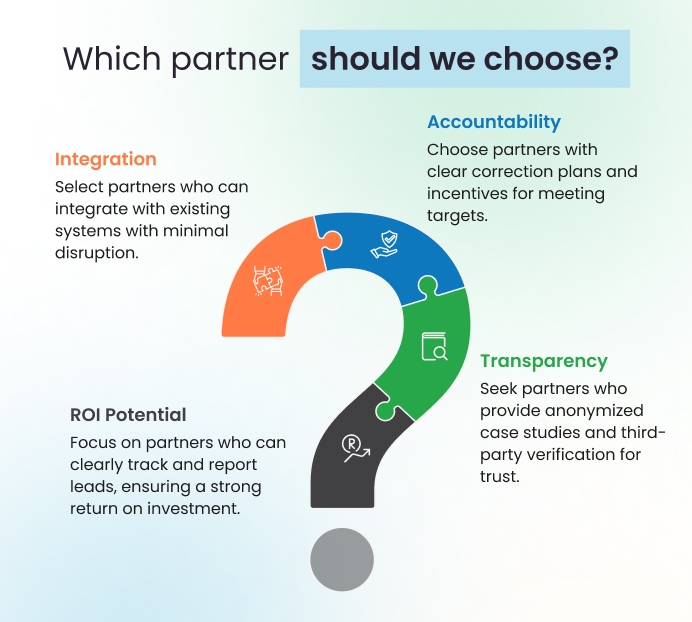
Zero in on ROI, transparency, and accountability: Favor partners offering 90-day pilots, real-time reporting, and performance-based pricing to guarantee scalable patient growth.
Some of the red flags to dodge:
- Metrics are obsessed with vanity stats over revenue.
- Zero India/healthcare references.
- Evasive on reporting or guarantees.
- High upfront costs, no skin in the game.
- One-size-fits-all pitches ignore your clinic’s niche (e.g., bariatrics or oncology).
- No operations or CRM integration experience.
- Overpromising “quick wins” without sustainable systems.
If you spot these pitfalls early, you can always copy our checklist to vet and select your ideal growth ally.
- 2x+ ROI case studies from similar clinics.
- Weekly transparent dashboards.
- Enforceable SLAs and penalties.
- 90-day pilot option.
- Proven CRM/ops integration.
- Verifiable peer references.
This framework ensures you select a partner who fuels lasting growth.
The Future of Healthcare Growth in India
India’s healthcare market is expected to reach USD 610 billion by 2026, evolving from chasing sheer volume to delivering real value powered by AI smarts, Ayushman Bharat’s digital push, and a wave of new hospitals and clinics.
For busy doctors and owners like you, this means moving beyond promotional blasts to performance that truly counts. It’s about data revealing which leads turn into loyal patients, automations handling the grunt work so your team focuses on care, and patient journeys that feel personal—from that first WhatsApp query to post-op check-ins.
With diagnostics consolidating, AI transforming daily clinical decisions, home care booming, and GLP-1 drugs revolutionizing obesity treatment, growth consultants become your secret weapon. They’ll help you stay ahead of 500+ new competitors by 2030, comply with tightening rules, and connect deeply with India’s diverse patients.
Conclusion
Healthcare marketing agencies and growth consultants serve different purposes. Marketing agencies focus on generating visibility, running campaigns, and building brand presence. Growth consultants focus on improving conversions, strengthening patient journeys, and creating structured systems for long-term performance.
Both approaches work at different stages.
Early-stage hospitals benefit from marketing support to build awareness and attract inquiries. Growing and established organizations, however, need stronger systems to manage leads, improve follow-ups, and ensure consistent results. Without this foundation, even strong marketing fails to deliver sustainable growth.
This is where MedGrowthEngine.ai adds value. By integrating marketing, CRM, automation, and performance analytics, MedGrowthEngine.ai helps hospitals convert inquiries into predictable revenue systems. Book a consultation to assess your current setup, identify gaps, and build a clear roadmap for scalable, sustainable success.
Frequently Asked Questions
A healthcare marketing agency focuses mainly on branding, advertising, and lead generation. A healthcare growth consultant focuses on improving conversions, follow-ups, patient retention, and internal systems to ensure consistent and scalable business growth.
Marketing agencies are useful for building visibility and generating initial inquiries. Growth consultants are better suited to hospitals and clinics seeking to improve operational efficiency, increase conversions, and achieve long-term, predictable growth across regions.
Most healthcare organizations struggle due to delayed responses, weak call handling, inconsistent follow-ups, and a lack of integrated CRM systems. When these processes are not optimized, a large percentage of genuine inquiries never turn into confirmed appointments.
A healthcare growth consultant improves acquisition and retention by optimizing inquiry management, standardizing follow-ups, aligning marketing with operations, and using performance data. This creates a smoother patient journey and strengthens long-term engagement.
Hospitals can achieve predictable growth by integrating marketing, automation, CRM, and analytics into one unified system. Platforms like MedGrowthEngine.ai help healthcare organizations implement data-driven frameworks that focus on accountability, conversions, and sustainable revenue.