





Oct 12/2026

For years, dermatology marketing has been measured by easy-to-see numbers: likes, followers, impressions, reach, and engagement. But these metrics don’t always show whether your marketing is contributing to practice growth.
A post can receive thousands of likes and generate little patient value. At the same time, a treatment page, Google search, or WhatsApp inquiry with far less visible engagement may come from a patient who is actively researching a procedure and ready to take the next step. This is the difference between attention, intent, and action, and it is becoming increasingly important for dermatology and aesthetic practices.
The real question is what happened after that interaction. MedGrowthEngine.ai takes a connected approach to dermatology and aesthetic marketing through its patient lead generation, Patient lead nurturing, and patient lead retention. Generate attracts high-intent patients, Nurture turns interest into consultations and treatments, and Retain builds long-term value through follow-ups, repeat treatments, and referrals.
This article covers the key metrics dermatology and aesthetic practices should track to understand patient intent, identify gaps in the patient journey, and measure what actually moves patients toward action.
What Should Dermatology Practices Actually Measure?
The most important marketing question for a dermatology practice is: How many people moved closer to care?
A patient may see an Instagram post, visit a website, read a treatment page, send a WhatsApp message, book a consultation, and eventually return for another treatment. Each interaction represents a different level of intent. Measuring only the first interaction can make marketing activity look successful without showing whether it is contributing to actual practice growth.
From Vanity Metrics to Actionable Growth Metrics
Vanity metrics (Reach, impressions, likes, followers, and video views) are not necessarily useless, as they can help practices understand whether content is attracting attention. The problem arises when these numbers become the primary measure of marketing success.
For example, a campaign that generates high engagement but few qualified inquiries may be creating awareness without creating meaningful patient intent. Conversely, a campaign with lower reach may generate fewer but more relevant inquiries that result in consultations and treatments.
The focus should shift from activity metrics to growth metrics. Instead of tracking followers, impressions, and likes, focus on qualified inquiries, high-intent website visits, and engagement with treatment pages. Similarly, measure lead quality, inquiry-to-booking rates, consultation bookings, and consultation-to-treatment conversion rather than simply counting leads, traffic, or clicks.
Measuring Patient Intent Across the Journey
Patient intent does not appear at one specific point. It develops throughout the journey. This makes the patient journey an important measurement framework, covering every stage from discovery and research to inquiry, booking, consultation, treatment, follow-up, retention, and referral.
At each stage, practices can ask a simple question: What action indicates that the patient is moving closer to care?
This could mean a treatment-page visit during research, an inquiry during evaluation, a conversation during nurturing, a booking after inquiry, or a completed treatment after consultation. Measuring these transitions provides more useful insight than treating every interaction as equal.
No Single Metric Can Explain Clinic Growth
Clinic growth is too complex to capture with one number. A practice may have strong website traffic but a low inquiry rate. It may generate many inquiries but lose opportunities because of slow response times. Looking at only one metric can therefore hide important gaps elsewhere in the journey. Instead, dermatology practices need to connect metrics across stages like visibility, engagement, intent, inquiry, booking, consultation, treatment, and retention.
This creates a more complete view of marketing performance and helps identify where potential patients are progressing and where they are dropping off.
Connecting Marketing to Real Practice Outcomes
Ultimately, marketing performance needs to connect to what happens inside the practice. The value of a campaign becomes clearer when that interaction contributes to a qualified inquiry, consultation, treatment, repeat visit, or referral.
It matters most when evaluating cosmetic surgery patient leads and other high-consideration aesthetic inquiries. Lead volume alone does not tell a practice whether leads are relevant, whether they received an appropriate response, or whether they eventually converted into patients.
That is the approach behind MedGrowthEngine.ai‘s Generate, Nurture, Retain framework. Instead of treating acquisition as the finish line, the framework looks at how practices generate patient demand, nurture intent, and retain patient relationships, connecting marketing activity with consultations, treatments, repeat care, and referrals.
GENERATE: Are We Attracting the Right Patient Intent?
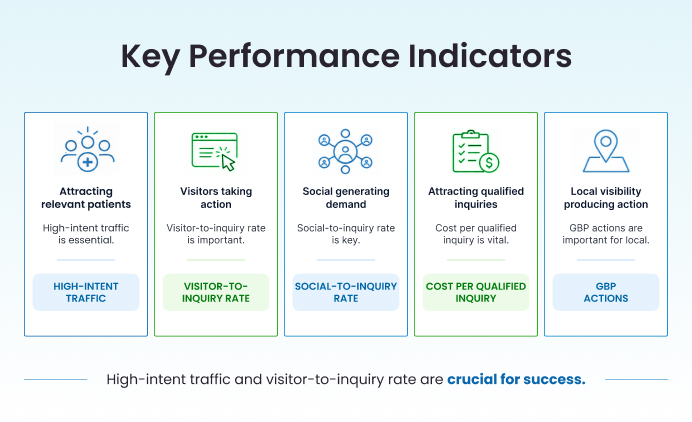
The Generate stage is about creating qualified demand, not simply increasing visibility. For cosmetic clinic lead generation, the right metrics show whether marketing is attracting people who are genuinely researching treatments and moving toward care.
This means looking beyond total lead volume to see which campaigns, search terms, treatment pages, social interactions, and local search actions generate qualified patient inquiries.
High-Intent Website Traffic
Not all website traffic has the same value. Compare organic traffic with treatment- or condition-specific traffic, and branded with non-branded search. Look at which pages attract visitors closest to taking action.
Metric: High-intent traffic %
Search-to-Action Rate
A Google search is only the beginning. Measure what visitors do next—whether they call, click WhatsApp, submit a form, or request an appointment.
Metric: Search visitor → inquiry conversion rate
Social Media Intent
Likes, views, and follower growth show attention, but not necessarily intent. Track profile visits, website clicks, WhatsApp clicks, and treatment-page visits to identify which content drives meaningful patient actions.
Metric: Social engagement → inquiry rate
Cost per Qualified Inquiry
Cost per lead can be misleading when lead quality varies—separate general inquiries from genuine treatment interest to understand what you are actually paying to generate.
Metric: Marketing spend ÷ qualified inquiries
Local Search and Reputation Signals
Local visibility can influence whether a patient takes the next step. Track Google Business Profile actions such as calls and direction requests, alongside review volume and quality, to understand how local reputation contributes to patient intent.
NURTURE: Are We Turning Patient Interest Into Consultations?
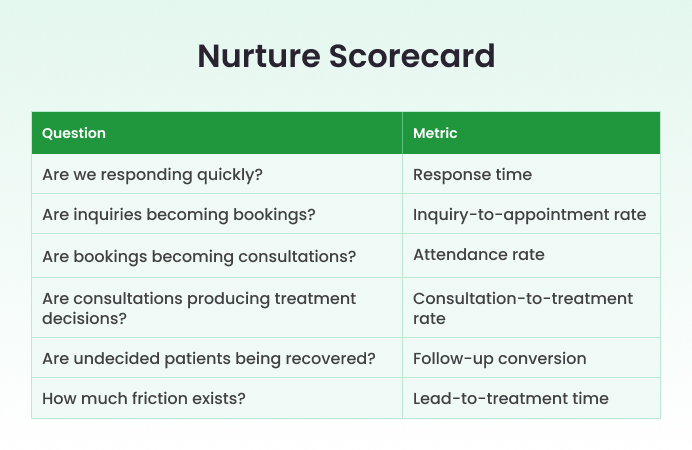
Generating interest is only the first step. The Nurture stage measures what happens after a patient raises their hand, how quickly the practice responds, how effectively inquiries become appointments, and whether that interest continues through consultation and treatment.
Inquiry Response Time
The first response is part of the marketing journey. Track how quickly the practice responds across WhatsApp, calls, forms, and social DMs. Faster, consistent responses can help prevent interested patients from dropping out before the conversation begins.
Metric: Median inquiry response time
Inquiry-to-Appointment Conversion
Not every inquiry becomes a booking. Measuring this conversion rate helps identify gaps between marketing-generated demand and the front-desk or patient-coordination process.
Metric: Inquiry → appointment rate
Appointment-to-Consultation Rate
A booked appointment only creates value when the patient attends the consultation. Reminders, confirmations, and pre-consultation communication can help reduce drop-offs and keep patients engaged.
Metric: Appointment → attended consultation rate
Consultation-to-Treatment Conversion
Marketing performance should not stop at the consultation booking. This metric shows whether patient intent strengthens during the consultation or drops before treatment, helping practices identify where additional communication or follow-up may be needed.
Metric: Consultation → treatment conversion
Follow-Up Engagement
Some patients need more time before booking. Tracking follow-up engagement across WhatsApp, email, or other appropriate channels helps practices understand whether continued communication is bringing interested patients back into the journey.
Metric: Follow-up engagement/conversion rate
Lead-to-Patient Time
The journey from first inquiry to treatment should not contain unnecessary friction. Measuring how long patients take to move through this process can reveal delays in response, booking, consultation, or follow-up.
Metric: Average lead-to-treatment time
Where are your inquiries dropping off?
Find out with the Clinic Growth AuditRETAIN: Are We Creating Long-Term Patient Value?
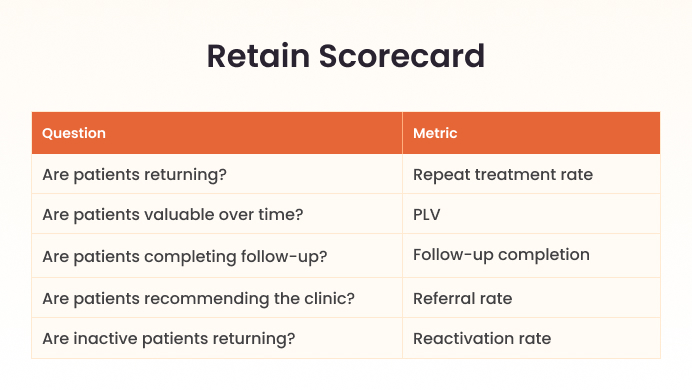
A patient journey does not end when treatment is completed. The Retain stage looks at what happens afterward, whether patients return, remain engaged, complete follow-ups, and become advocates for the practice. These metrics help connect marketing performance with long-term patient value.
Repeat Treatment Rate
A practice may generate strong first-time patient acquisition but still struggle to build lasting relationships. Track returning patients versus one-time patients and, where relevant, measure retention by treatment category.
Metric: Repeat patient rate
Patient Lifetime Value
A patient’s value extends beyond their first treatment. Patient Lifetime Value (PLV) measures the revenue generated throughout the patient relationship, providing context for how much the practice can reasonably invest in acquiring and retaining patients.
Metric: Patient Lifetime Value (PLV)
Follow-Up Completion
Post-treatment communication is an important part of the patient experience. Track whether patients complete recommended follow-ups and remain engaged with ongoing care.
Metric: Follow-up completion rate
Review and Referral Rate
A positive patient experience can contribute to both retention and future acquisition. Reviews help strengthen online reputation, while referrals can bring new patients through existing patient relationships.
Metric: Review/referral rate
Patient Reactivation
Not every patient returns within the expected timeframe. Identifying inactive patients can reveal opportunities for appropriate, timely re-engagement based on their previous treatment or care journey.
Metric: Reactivation rate
Together, these metrics help practices look beyond the first conversion and understand whether their marketing and patient experience are creating long-term patient relationships, repeat care, and sustainable value.
The Metrics That Connect Generate, Nurture, and Retain
Patient lead generation, nurturing, and retention are not separate activities. Each stage influences the next, creating a connected patient journey. Tapping into this patinet full journey helps practices understand not just where patients come from, but how marketing contributes to acquisition, conversion, and long-term patient value.
The Full-Funnel Metrics That Matter
Individual channel metrics tell only part of the story. Full-funnel metrics connect marketing activity with actual patient and business outcomes.
- Qualified Patient Acquisition Cost: How much it costs to acquire a genuinely qualified patient.
- Inquiry-to-Treatment Conversion: How many inquiries ultimately become treated patients.
- Cost per Consultation: The marketing cost to generate an attended consultation.
- Cost per Acquired Patient: The overall cost of acquiring a new patient.
- Patient Lifetime Value (PLV): The value generated across the patient’s relationship with the practice.
- LTV:CAC: The relationship between patient lifetime value and acquisition cost.
- Repeat Patient Contribution: The contribution of returning patients to overall practice revenue.
- Referral Contribution: The contribution of referrals to new patient acquisition.
These metrics create a clearer connection between marketing spend and patient value. Instead of asking which campaign received the most engagement, practices can start asking which activities generate qualified patients, support treatment decisions, and contribute to repeat and referral-driven growth.
Why Channel-Level Metrics Can Give Dermatology Practices the Wrong Answer
Looking at each marketing channel in isolation can create an incomplete picture of what drives practice growth. A channel may appear successful based on its own metrics while contributing little to the overall patient journey.
High Engagement Does Not Always Mean High Intent
A high-performing Instagram post can generate thousands of views, likes, or shares while producing few or no patient inquiries. Its role may be awareness rather than direct conversion, so engagement alone cannot determine its business value.
Low Traffic Can Still Deliver High-Value Patients
An SEO page may attract relatively little traffic but rank for a specific treatment- or condition-related search and generate highly qualified patients. Traffic volume alone doesn’t indicate demand quality.
Lower Volume Can Mean Higher Conversion
WhatsApp may generate fewer interactions than social media or other channels, but patients who initiate a conversation may have stronger intent and be closer to booking a consultation. Measuring volume without conversion can therefore hide its contribution.
Leads Are Not the Same as Patients
A campaign can generate many leads without producing a corresponding number of consultations or treatments. Evaluate lead volume alongside lead quality, booking rates, consultation attendance, and treatment conversion.
Measure the Source and the Journey Together
A patient’s source matters, but so does everything that happens after the first interaction. Understanding where the patient came from, what action they took, how they were nurtured, and whether they ultimately converted and returned provides a more complete view of marketing performance.
That is why MedGrowthEngine.ai connects channel data with the patient journey, helping practices measure which channel contributed to cosmetic clinic lead generation and what those inquiries ultimately became.
Build a Dermatology Marketing Scorecard Around Patient Intent
Instead of tracking dozens of disconnected marketing numbers, dermatology practices can use a patient-intent scorecard to understand how effectively their marketing generates demand, converts interest, and creates long-term patient value.
Build Your Clinic Growth Scorecard
- Generate: Are we attracting the right patients?
Measure high-intent traffic, qualified inquiries, social-to-inquiry rate, and cost per qualified inquiry. - Nurture: Are interested patients becoming treatments?
Measure response time, booking and consultation rates, treatment conversion, and follow-up conversion. - Retain: Are patients creating value beyond their first treatment?
Measure repeat treatments, follow-up completion, Patient Lifetime Value, reviews, referrals, and reactivation.
Overall Clinic Growth Score
The individual scores can be brought together into a simple view of the three outcomes that matter most: Demand, Conversion, and Patient Value.
This gives practices a clearer way to identify where patient intent is strongest, where opportunities are being lost, and which parts of the journey need attention.
For MedGrowthEngine.ai, the scorecard provides a practical way to assess the complete journey rather than evaluating marketing through isolated channel metrics.
How MedGrowthEngine.ai Can Turn Marketing Data Into Growth Decisions
For a dermatology or aesthetic practice, effective cosmetic clinic lead generation should not be measured only by the number of leads generated. The bigger question is whether those leads are qualified, nurtured effectively, and move through the journey toward consultation, treatment, repeat care, and referral.
MedGrowthEngine.ai connects these stages so practices can understand the relationship between marketing activity and patient outcomes.
Connect Marketing, Inquiry, and Patient-Journey Data
Bring data from marketing channels, website activity, inquiries, bookings, consultations, treatments, and follow-ups into a connected view. This helps practices understand what happens after a patient first engages with marketing.
Identify Where Patients Are Dropping Off
A connected patient journey makes it easier to identify gaps such as website to inquiry, inquiry to booking, booking to consultation, or consultation to treatment. These drop-offs can highlight where improvements are needed.
Understand Which Channels Generate Qualified Demand
Go beyond asking which channel generates the most leads. MedGrowthEngine.ai can help practices understand which channels drive qualified inquiries, consultations, and treatments, giving greater context to channel performance.
Track Patient Journey Performance.
The framework brings key metrics together across all three stages—Generate demand, Nurture patient interest, and Retain long-term value. This creates a clearer picture of how marketing contributes to overall practice growth.
Move From Monthly Reporting to Actionable Growth Insights
Reports often explain what happened. Growth insights should help answer what should happen next. Instead of reviewing numbers once a month, practices can use connected data to identify trends, gaps, and opportunities that require attention.
Use AI and Automation to Reduce Manual Work
AI and automation can help reduce repetitive data collection, reporting, and analysis while surfacing potential opportunities more efficiently. This allows teams to spend less time compiling numbers and more time acting on insights that can improve the patient journey.
What a Dermatology Practice Should Review Every Month
A monthly marketing review should go beyond campaign performance and reporting. It should help a dermatology practice understand where patient intent is created, where it’s lost, and what needs to change next.
A practical monthly audit can include:
- Generate: Are we attracting enough qualified patient intent through search, social, website, and other channels?
- Nurture: Are inquiries progressing to bookings, consultations, and treatments, or are patients dropping off along the way?
- Retain: Are treated patients returning for relevant future care, completing follow-ups, leaving reviews, or referring others?
- Efficiency: Which channels are producing the strongest patient economics, from qualified inquiry through treatment and retention?
- Gaps: Where is the biggest drop-off in the patient journey, and what might be contributing to it?
- Action: Based on the data, what should the clinic change next month? This could mean improving a landing page, response process, follow-up sequence, campaign, or retention strategy.
A monthly audit turns numbers into clear priorities and actionable growth decisions.
Conclusion
Likes, views, and followers show attention, but they do not show whether patients are moving closer to care. What matters is tracking intent across the journey, from discovery and inquiry to consultation, treatment, and retention.
The Generate, Nurture, and Retain framework helps dermatology and aesthetic practices connect these stages and identify where opportunities are being lost. Whether you are investing in cosmetic clinic lead generation, evaluating cosmetic surgery patient leads, or working with a marketing agency for cosmetic clinics, focus on meaningful patient outcomes, not just lead volume.
MedGrowthEngine.ai brings these metrics together to help practices understand patient intent and make better growth decisions.
Stop asking, How many people saw us? Start asking, How many patients moved closer to care, and what happened next?
Find Where Your Clinic Is Losing Patient Intent
Get Your Clinic Growth AuditFrequently Asked Questions
Likes, followers, impressions, and reach primarily show attention. Patient-intent metrics show whether people are taking meaningful steps toward care, such as visiting treatment pages, making inquiries, booking consultations, or proceeding with treatment.
A cosmetic clinic should look beyond total lead volume and track metrics such as qualified inquiries, cost per qualified inquiry, inquiry-to-booking rate, consultation-to-treatment conversion, and lead-to-treatment time. These metrics provide a clearer view of whether cosmetic clinic lead generation is producing meaningful patient opportunities.
A marketing agency for cosmetic clinics can connect marketing activity to the full patient journey—from search and social media to website visits, inquiries, follow-up, bookings, consultations, and treatment. This makes it easier to identify where potential patients are dropping off and where improvements are needed.
Evaluate cosmetic surgery patient leads based on more than quantity. Practices should consider lead quality, treatment interest, response time, booking rate, consultation attendance, treatment conversion, and follow-up engagement to understand the actual value of those leads.
The Patient lead generation, nurturing, and retention framework looks at three connected stages of practice growth. Generate focuses on attracting qualified patient demand, Nurture focuses on converting interest into consultations and treatments, and Retain focuses on follow-up, repeat care, reviews, referrals, and long-term patient relationships.