





Sep 21/2026
A rational, cosmetic patient journey starts with a Google search, an Instagram post, a recommendation, or an online review. After that, they might visit a treatment page, check the dermatologist’s qualifications, compare reviews, review results, send a WhatsApp message, call the clinic, or go back to social media before deciding to book.
Acquiring patients is therefore more than visibility; it is a journey-management issue.
Even with a strong Instagram presence, the website still needs to answer patient questions, and slow responses can quickly turn interest into a lost inquiry. WhatsApp and calls may help convert inquiries into appointments, but without a connected CRM, valuable leads can still slip through. The journey doesn’t end at consultation; it continues through treatment decisions, follow-ups, repeat treatments, and referrals.
For a cosmetic practice, a Cosmetic Clinic Marketing Agency should focus on connecting the entire patient journey, from search and social interaction to inquiry, consultation, treatment, and retention.
MedGrowthEngine.ai helps cosmetic and aesthetic practices connect this journey, automate repetitive communication, and identify where opportunities are being won or lost.
This article explores how channels, technology, automation, and human interaction can work together to create a more connected and effective patient journey.
How Has The Aesthetic Patient Journey Changed?
From an aesthetic perspective, the patient journey usually go back and forth between searching, using social media, visiting websites, reading reviews, and engaging in direct conversation before they are ready to take the next step.
A patient might find a clinic on Google while searching for treatment, check the doctor’s expertise on the clinic’s Instagram page, read reviews to assess credibility, and then visit the website to learn more. Once they are ready to ask a question, the interaction might shift to WhatsApp or a phone call; afterward, the experience depends on how well the practice responds, follows up with the patient, and helps them get to a consultation.
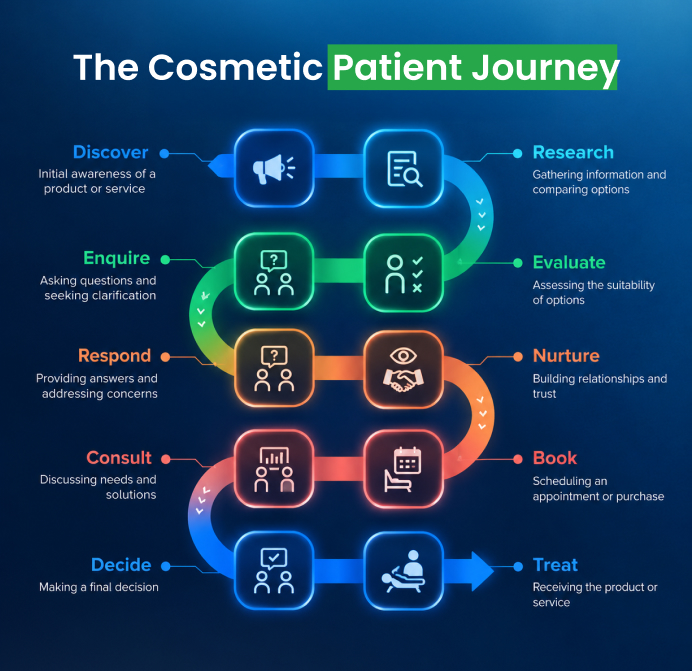
Each stage serves a different function, and each channel should support the next step.
The important point is that no single channel owns the entire journey.
- Search may create the initial intent
- Social media may build familiarity
- The website may provide the information needed to evaluate the practice
- And WhatsApp or a phone call may turn interest into an actual conversation.
For a Cosmetic Clinic Marketing Agency, this changes the way patient acquisition should be approached. The objective is to ensure every interaction gives the patient a clear, relevant next step.
This connected approach also changes how practices think about Cosmetic Surgery Patient Leads. Generating an inquiry is only one part of the process. The real opportunity lies in understanding where that patient came from, what they are interested in, how quickly they received a response, whether they booked a consultation, and what happened after the consultation.
When you connect the stages of the patient journey, the practice can create a more consistent patient experience while gaining a clearer view of what drives consultations and long-term patient relationships.
Stage 1: Discovery- Where Do Patients First Find an Aesthetic Practice?
The aesthetic patient journey can begin anywhere: Google Search, Instagram, a referral, or an online review. Each channel creates a different type of interest, but the goal is to move the patient to the next relevant touchpoint.
- Google Search (Capturing Existing Intent): Patients searching for a treatment, skin concern, or cosmetic procedure already have a need they want to explore. Search helps practices capture this intent through relevant treatment pages, local visibility, and useful content.
- Instagram (Creating Interest): Instagram often introduces patients to treatments, doctors, and clinics before they are ready to inquire. Educational content, expertise, and patient-focused information can encourage them to explore further.
- Reviews (Building Confidence): Patients often check reviews before deciding whether to explore a practice further. Strong reviews can reinforce credibility across both search and social discovery.
For a Cosmetic Clinic Marketing Agency, the goal is to ensure that every discovery channel gives the patient a clear path forward.
That next step takes the patient from discovery to research, where the website becomes critical.
Key Takeaway: Be visible where patients are looking, and give them a clear next step.
Stage 2: Research- How Patients Evaluate Their Options
Discovery creates interest, but patients rarely inquire immediately. They usually research the clinic, doctor, and treatment before taking the next step.
The website bridges interest and intent.
Patients may look for:
- Treatment information and expected outcomes
- Doctor credentials and experience
- Before-and-after results, where appropriate
- Reviews and patient experiences
- Safety, recovery, and common questions
- Clear pricing or consultation information
- An easy way to inquire or book
The key is consistency. If an Instagram post creates interest in a treatment, the linked website page should answer the questions that naturally follow.
Instagram → Treatment Page → Trust & Information → WhatsApp / Call / Booking
The same applies to search. A patient who finds a treatment page through Google should not have to search again for basic information or figure out how to contact the clinic.
For a Cosmetic Clinic Marketing Agency, this stage turns attention into informed patient intent. The website should not just provide information—it should make the next step easy. Once the patient has enough information and confidence, the journey moves from research to inquiry.
Key Takeaway: Turn interest into confidence with relevant information and proof.
Stage 3: Inquiry- What Happens When a Patient Reaches Out?
Once a patient feels informed enough to take action, they move from research to inquiry. This may happen through WhatsApp, a phone call, a website form, or a social media DM.
At this stage, convenience matters. Patients should not have to search for contact details or repeat information across multiple channels.
The first response also matters. A delayed, unclear, or generic response can cause a high-intent patient to lose interest or explore another practice. A connected system can capture the inquiry, record its source, and ensure the right team member follows up. This is where a Patient Management System (PMS) becomes important, bringing website, WhatsApp, calls, and other inquiries into one view.
For a marketing agency serving a cosmetic clinic, the objective is to help practices respond faster, track every opportunity, and move qualified inquiries toward consultation.
An inquiry is not a conversion. It is the point where the practice has to earn the next step.
Key Takeaway: Make it easy to ask and respond before interest fades.
Stage 4: Nurture- Keeping the Patient Conversation Moving
Not every patient who inquires is ready to book immediately. They may have questions about the treatment, cost, safety, recovery, or whether it is right for them. This is where structured follow-up helps keep the patient engaged without making the interaction feel like a sales process.
WhatsApp, calls, and email can support this stage, while a PMS helps the practice track who has inquired, what they are interested in, and when to follow up.
Follow-up can include:
- Answers to common treatment questions
- Relevant educational content
- Consultation information
- Appointment availability
- Appropriate reminders
Automation can handle repetitive communication, but conversations that involve personal concerns or complex questions should remain human-led.
Key Takeaway: Keep the conversation relevant until the patient is ready to act.
Stage 5: Booking- Turning Patient Intent Into an Appointment
Once a patient is ready to move forward, booking should feel simple and immediate. Every extra step creates an opportunity for the patient to drop off.
A connected booking process should make it easy for patients to:
- See available consultation slots
- Choose a convenient time
- Receive confirmation instantly
- Get reminders before the appointment
- Contact the clinic if you have questions
The process should also connect back to the PMS, so the practice can track whether an inquiry became a booking and whether the patient actually attended. This creates an important metric for practices: not just how many inquiries were generated, but how many became consultations.
Automation can handle confirmations and reminders, while the clinic team remains available when patients need personal assistance.
Key Takeaway: Remove friction between intent and consultation.
Stage 6: Consultation- Where Digital Intent Meets Human Expertise
A booked appointment is not the end of the patient journey. The consultation is where the patient evaluates the doctor, discusses their goals, and decides whether they feel confident moving forward.
By this stage, the patient may already have researched the treatment, reviewed the doctor’s credentials, and interacted with the clinic several times. The consultation needs to build on that experience.
A strong consultation should help patients:
- Explain their concerns and expectations
- Understand suitable treatment options
- Discuss outcomes, risks, and recovery
- Ask questions and address concerns
- Make an informed decision about the next step
The digital experience still matters here. Information collected through the inquiry or booking process can help the team understand the patient’s needs before the consultation, while follow-up communication can support questions that arise afterward.
For practices working with a Cosmetic Clinic Marketing Agency, this shift matters: marketing should not end when the patient walks through the clinic door. The goal is to create a consistent experience that carries the patient from the first digital interaction into a meaningful consultation.
Technology can help create the opportunity. The consultation is where human expertise builds the confidence to act.
Key Takeaway: Technology creates the opportunity; human expertise builds trust.
Stage 7: Procedure Decision- Why Patients Say Yes, Not Yet, or No
A consultation can build trust, but the patient may still need time to decide. They may compare options, discuss costs, consider recovery time, or simply want to think about the recommendation.
This is where timely, relevant follow-up can support the decision without pressuring the patient.
The practice can support this stage by providing:
- Clear information about the recommended procedure
- Expected outcomes and recovery
- Answers to questions that arise after consultation
- Appointment or procedure availability
- Appropriate follow-up for patients who need more time
PMS data can help the team identify patients who have consulted but have not yet proceeded, while automated communication can support routine follow-ups.
For a Marketing Agency for a cosmetic clinic, this stage matters because the objective is not simply to generate Cosmetic Surgery Patient Leads. It is to understand what happens to those leads after they reach the practice and where additional support may help them move forward.
The right follow-up does not push the patient toward a decision; it helps them make a more informed one.
Key Takeaway: Support informed decisions without pressuring the patient.
Stage 8: Treatment Experience- Delivering on the Promise
Once the patient decides to proceed, the focus shifts from conversion to experience. Everything the patient has seen and heard online has created expectations for the treatment and the practice.
Clear communication before the procedure can help patients understand what to expect, including preparation, timelines, recovery, and follow-up. During treatment, the clinical team delivers safe, personalized care.
The digital journey can still support the experience through:
- Pre-treatment instructions and reminders
- Appointment and preparation communication
- Easy access to relevant information
- Clear post-treatment guidance
- Timely follow-up messages
This is also where consistency matters. If marketing promises one experience but the actual patient experience feels very different, trust can quickly decline.
For practices working with a Cosmetic Clinic Marketing Agency, the objective should therefore extend beyond generating leads. Marketing, communication, and patient experience should work together to create a journey that continues from the first interaction through treatment and beyond.
A successful patient journey doesn’t just get someone to the clinic—it delivers an experience worth continuing.
Key Takeaway: Deliver an experience that matches the promise made online.
Stage 9: Post-Treatment Communication- Turning a Procedure Into an Ongoing Relationship
The patient’s journey does not end after treatment. Post-treatment communication helps patients understand their recovery, know what to expect, and feel supported after leaving the clinic.
Relevant communication may include:
- Post-treatment instructions and reminders
- Recovery check-ins
- Answers to common questions
- Follow-up appointment reminders
- Requests for feedback or reviews at the appropriate time
Automation can support routine reminders and check-ins, while the clinical team should handle questions or concerns that require professional judgment.
A connected PMS can also help the practice track follow-up status and identify patients who may need further communication.
For a Cosmetic Clinic Marketing Agency, this stage shows why patient acquisition should not be measured only by the initial consultation or procedure. A well-managed post-treatment experience can create the foundation for repeat treatments, reviews, and referrals.
The treatment may be complete, but the patient relationship should continue.
Key Takeaway: Stay connected after treatment to support the patient journey.
Stage 10: Repeat Treatment- Moving From a One-Time Patient to a Long-Term Relationship
Many aesthetic treatments require maintenance, multiple sessions, or future treatment. This creates an opportunity to stay connected with patients after their initial procedure.
The practice can use previous treatment and communication data to make follow-up more relevant, such as:
- Reminding patients about scheduled or recommended follow-ups
- Sharing relevant education and care information
- Communicating when another session may be due
- Personalizing communication based on the patient’s treatment journey
A PMS can help track these interactions, while automation can manage routine reminders without making communication feel repetitive or promotional.
For a Cosmetic Clinic Marketing Agency, retention should be viewed as part of patient acquisition economics. A patient who returns for appropriate ongoing care can create greater long-term value than a one-time patient.
The goal is not to communicate more often. It is to communicate when the patient has a relevant reason to hear from the practice.
Key Takeaway: Use timely, relevant communication to build long-term relationships.
Stage 11: Referral- Turning Patient Satisfaction Into Advocacy
A satisfied patient can become more than a returning patient—they can become an advocate for the practice. Reviews and personal referrals can introduce new patients who already have some trust before they make their first inquiry.
Practices can support advocacy by:
- Making it easy for patients to leave genuine reviews
- Following up appropriately after treatment
- Encouraging patients to share their experience when they are satisfied
- Maintaining relationships that keep the practice top of mind
This creates a continuous loop:
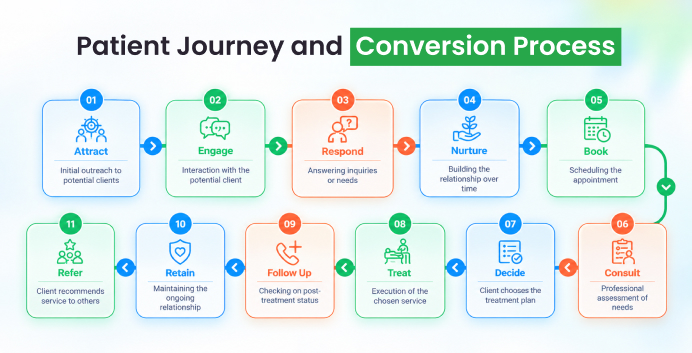
Discover → Inquire → Consult → Treat → Follow Up → Return → Refer → New Patient
For a Cosmetic Clinic Marketing Agency, this is where acquisition and retention connect. The patients generated through search, social media, and other channels can eventually contribute to the next generation of patient acquisition through reviews and referrals.
The strongest patient journeys don’t end with a treatment. They create relationships that can bring patients back—and introduce others to the practice.
Key Takeaway: A positive patient experience can become your next source of growth.
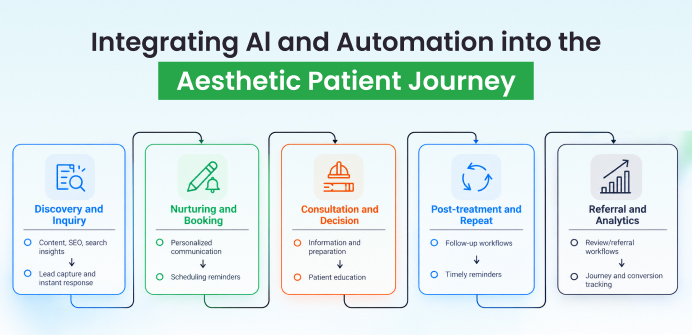
The Metrics That Matter at Each Stage of the Patient Journey
A patient journey consists of several stages, each of which calls for a different range of metrics; rather than assessing marketing success solely based on the number of leads, aesthetic clinics should monitor whether patients are coming across the correct services, engaging with the clinic, taking action, and making progress towards treatment and long-term relationships.
Discovery & Awareness
- Search Visibility: Explains just how simple it is for potential patients to locate your clinic and treatment services using appropriate searches.
- Website Engagement: It assesses whether visitors interact with your website rather than just visiting and leaving.
- Treatment-Page Engagement: It helps determine whether patients show meaningful interest in particular procedures or treatments.
Inquiry & Conversion
- Inquiry Volume: It tracks the number of calls, WhatsApp conversations, forms, direct messages, and other patient inquiries.
- Response Time: Measures how quickly your team replies to new inquiries; faster responses can help stop high-intent patients from leaving.
- Qualified Inquiry Rate: Indicates the percentage of inquiries that relate to the clinic’s services and its target patient profile.
- Inquiry-To-Booking Rate: Assesses how effectively inquiries turn into consultations or appointment bookings.
Consultation & Treatment
- Consultation Attendance: Tracks how many booked patients show up for their consultation.
- Consultation-To-Procedure Conversion: Demonstrates the extent to which consultations lead to treatment decisions.
- Treatment Completion: Measures the number of procedures or treatments completed, not just booked appointments.
Retention & Advocacy
- Follow-Up Engagement: It records how patients interact with post-treatment communication, reminders, and follow-up procedures.
- Repeat Treatment Rate: Shows how often current patients return for further or ongoing treatments.
- Referral Rate: Measures the extent to which satisfied patients contribute to acquiring new patients through referrals.
Business & Growth
- Patient Acquisition Cost (PAC): Explains the cost involved in obtaining a new patient through marketing and acquisition activities.
- Patient Lifetime Value (PLV): It estimates the longer-term value a patient creates through repeat treatments, ongoing care, and referrals.
- Measure Progress Across the Journey: The most useful dashboard connects these metrics rather than viewing them in isolation.
As a result, clinics will better understand where patients are making progress, where they stop coming, and which parts of the marketing and patient experience need improvement.
Common Gaps in the Modern Aesthetic Patient Journey
Even if aesthetic clinics spend a lot on marketing, they can still lose potential patients between first contact and the end of treatment. The issue is usually not a lack of activity but disjointed experiences throughout the patient journey.
Some of the most common gaps include:
Strong Instagram Presence, Weak Search Visibility
Even if a clinic has an active Instagram account with appealing content and good engagement, it can still be hard to locate when potential patients search for a particular treatment or concern.
Social visibility builds awareness, but search visibility captures existing treatment intent.
Leads Generated, But Slow Inquiry Response
Making inquiries is only one part of the process; if calls, WhatsApp messages, forms, or direct messages go unanswered for too long, potential patients may lose interest or contact a different clinic.
A strong acquisition strategy requires a quick, consistent response process.
Little Communication After Treatment
The patient relationship must not end when the procedure is complete; without structured follow-up, clinics miss the chance to support patients, prompt reviews, address concerns, and keep them engaged.
Post-treatment communication is an important part of the overall patient experience.
Since many aesthetic treatments allow for continued care, maintenance, or additional treatments, clinics often rely on patients to come back on their own. Clinics lose valuable opportunities for further treatments when patients don’t receive timely reminders and personal communication. Reviews are one of the most powerful trust signals for potential patients, yet many clinics wait until after a patient leaves to request them. A steady review process can turn good patient experiences into a stronger digital reputation. A steady review process can help transform good patient experiences into a stronger digital reputation.
Marketing
Although traffic, clicks, impressions, and leads may look healthy, the number of actual appointments or procedures has not increased. The bigger gap usually lies in the lack of a connection between marketing activities and patient outcomes.
The Bigger Issue: A Disconnected Journey
Although these gaps may seem separate, they are usually related.
A patient could come across a clinic on Instagram, search for the services it offers, visit its website, send a WhatsApp message, wait a long time for a reply, and never reach the consultation stage.
The opportunity is not simply to improve individual channels. It is to create a connected patient journey where marketing, communication, booking, treatment, follow-up, and retention work together.
Conclusion
The modern aesthetic patient journey does not begin with a consultation, and it certainly does not end with one.
Patients may discover a practice through Google or Instagram, research through the website and reviews, inquire through WhatsApp or phone, and then move through booking, consultation, treatment, and follow-up. Each interaction shapes their decision and their experience.
For practices, the opportunity is to connect these touchpoints rather than manage them in isolation.
Search creates discovery. Social builds interest. The website builds confidence. WhatsApp and CRM support conversion. Consultation builds trust. Follow-up builds relationships. Repeat visits and referrals create long-term value.
This is where MedGrowthEngine.ai approaches aesthetic growth differently. The focus is not simply on generating more traffic, social engagement, or leads. It is about connecting the patient journey and understanding what happens at every stage, from the first interaction to consultation, treatment, and beyond.
Sustainable growth is not about having more marketing channels. It is about making every touchpoint work together to move the right patient forward.
What Happens After Your Patient Finds You?
Book a Demo with UsFrequently Asked Questions
The modern cosmetic patient journey often begins with a Google search, Instagram interaction, or online content. It continues through website research, inquiry, WhatsApp communication, consultation, procedure decision, treatment, follow-up, and repeat visits.
Google helps patients actively looking for treatments, clinics, or solutions discover providers, while Instagram can shape awareness and interest through visual content, results, and patient experiences. Together, these channels can help generate cosmetic surgery patient leads by guiding patients to useful information and a clear next step.
After an inquiry, timely responses, relevant treatment information, WhatsApp or email communication, appointment reminders, and personalized follow-ups can help patients move from initial interest to consultation. A marketing agency for a cosmetic clinic can create structured nurture journeys so potential patients do not get lost after the first inquiry.
A consultation is an important decision point, but it is not the end of the patient journey. Patients may need more information before choosing a procedure, then need booking support, post-treatment communication, recovery follow-ups, and reminders for future treatments.
A Cosmetic Clinic Marketing Agency can connect search, social media, website, WhatsApp, CRM, booking, follow-up, and retention activities into a more measurable journey. Instead of focusing only on generating cosmetic surgery patient leads, the goal is to understand what happens from the first interaction through consultation, treatment, repeat visits, and referrals.